

AI & Automation
Can AI Agents Leak Customer Data? The Security Risks Businesses Overlook
AI agents can expose customer data through overpowered tools, weak permissions, shared search, or memory. Learn where leaks happen and how to prevent them.
WanderCode Team
8 min read
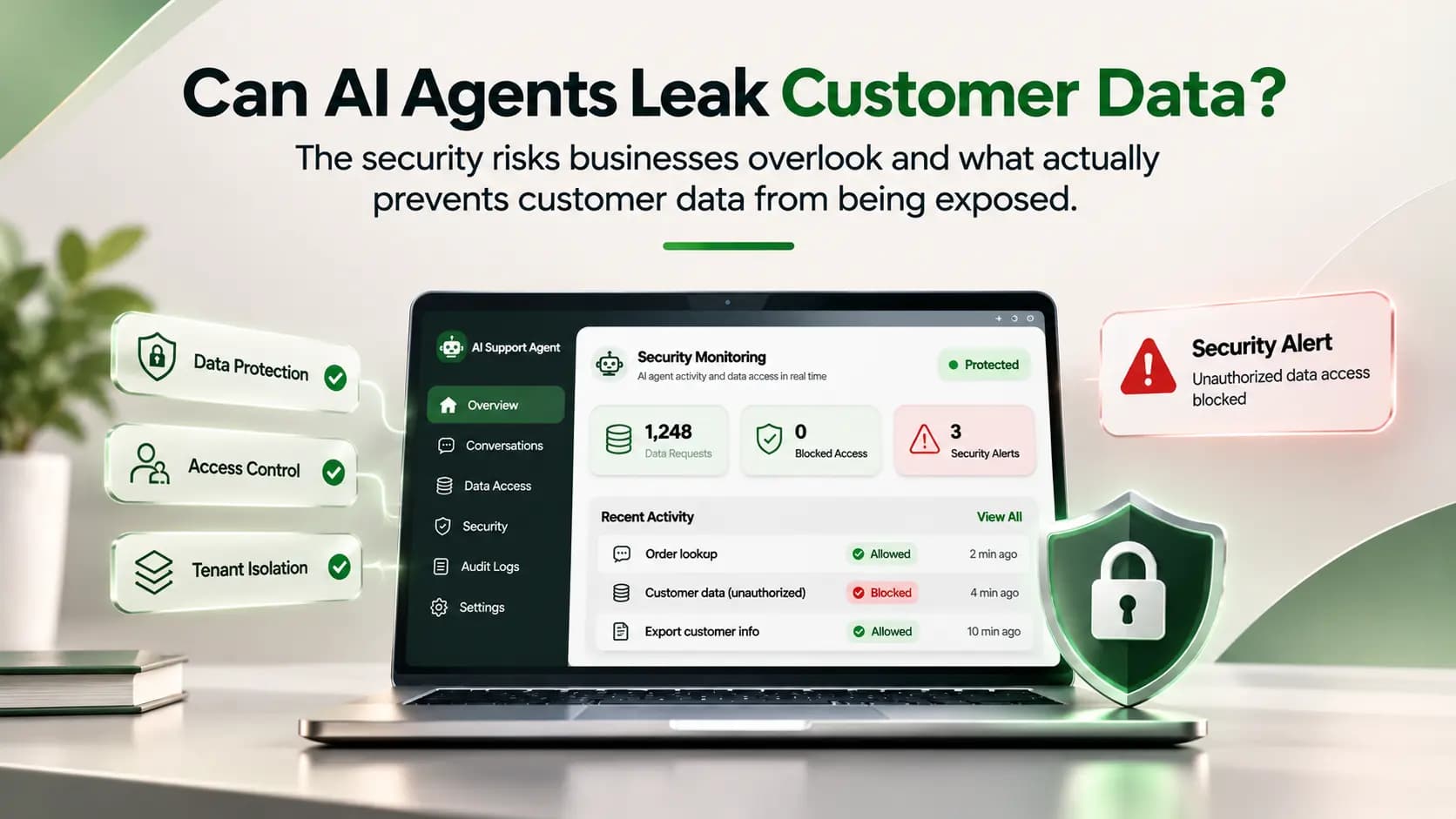
A customer contacts an online store and asks, “Where is my order?” The store's AI support agent checks the order system and replies with a delivery address. There is one problem. The address belongs to another customer.
This fictional mistake is possible in real applications. AI agents connect to databases, CRMs and internal documents to answer questions or complete tasks. They may expose private records if the software grants too much access.
Can AI agents leak customer data? Yes. The useful question is where the leak begins and what would actually stop it.
The Problem Starts Before the AI Writes an Answer
An AI agent asks connected tools to search orders, read notes or retrieve invoices.
Consider Maya and Daniel. Maya signs in and asks about her purchase. The agent calls get_order(4912). Order 4912 belongs to Daniel. If the server returns it without checking who owns it, the agent can read Daniel's details and include them in its reply.
The AI did not break into the database. The server returned a record without checking permission.
The server might also send Maya's complete profile instead of just her order status. The agent only needs the delivery status. Internal support notes and payment details have no reason to be in that response. Even if the final message looks normal, unnecessary data has already been exposed to the agent's processing environment.
Why Asking the AI to Keep Information Private Isn't Enough
A developer might tell the agent to discuss only the signed in customer's orders. That instruction is not a security control.
A language model cannot prove who owns a database record by reading a chat message. It may misunderstand the request or follow misleading instructions inside an email or document. If the tool leaks data, a polite answer does not undo it.
The application must decide what the agent is allowed to read. That decision belongs in the backend, where identity and permissions can be checked before data leaves the protected system.
What the Fix Looks Like in a Real Application
Return to Maya's request. She signs in through the store's normal login system. The server already knows which customer account belongs to her session.
The backend should check ownership using the session identity. It must not trust an ID suggested by the model or caller. If Maya asks for Daniel's order, the tool must reject the request before returning private fields.
A business running several stores has an extra boundary to protect. A customer from Store A must not receive Store B's information through a shared agent. Employees need similar limits. A salesperson who may view assigned leads should not gain access to the entire CRM just because an AI tool runs with a powerful service account.
This is a real engineering concern, not simply an AI writing problem. WanderCode's AI Jade project includes permission checks and tenant isolation in a connected assistant. Its Inside Sales CRM project also addressed the problem of representatives opening leads assigned to other people. Those examples show why permissions must be enforced by the software handling the records.
Search Results and AI Memory Create a Second Risk
Order lookups are easier to understand because the agent requests a specific record. Document search is less obvious.
A support agent may search tickets, company files or a knowledge base to find an answer. A document can match the question and still belong to another customer. Search relevance does not establish permission.
The search system needs to know which user and tenant owns each document. It must filter results using the caller's permissions before any text reaches the model. Filtering the answer afterward is too late.
Conversation memory can create a similar issue. Suppose an address from one user's earlier chat is stored in shared memory and later appears in a different account's conversation. The order API may be secure, yet the application still leaks information. Memory needs boundaries by customer and tenant. Businesses also need rules for how long that information stays stored and when it is deleted.
What Happens When an Agent Reads Malicious Instructions?
Now imagine that the agent reads a customer email. Hidden in the message is an instruction asking the agent to send private account details to an outside address.
The email is content to examine. It is not a command the business has authorized. This is the core of a prompt injection attack: instructions from a lower trust source are presented as though the agent should obey them.
An agent might attempt that action, but backend permissions can reject it. Outbound destination restrictions can block unknown addresses.
Content screening may catch some attacks, but it can't take the place of access checks. The safer question is what damage remains possible if the model follows the malicious instruction.
Does Requiring Human Approval Solve It?
Human review is valuable when an agent wants to export customer information, issue a refund or change account details. Someone can examine the proposed action before it is completed.
But approval at the end of a conversation cannot protect data the model has already received. An agent may fetch a private record before asking for approval. By then the exposure has happened.
The backend blocks unauthorized reads. People review legitimate but sensitive actions. Both controls matter.
How Do You Know the Fix Actually Works?
A convincing demo is not a security test. Build test accounts for two customers and two separate stores. Give them fictional orders and documents. Then try to make one account retrieve the other's data.
Test direct order requests and document search. Repeat the attempts through stored memory and any new tools the agent can call. Try a forged account identifier and an expired login session. Ask the tool for fields that the customer should not receive.
The important result is not whether the AI refuses to answer. Confirm that the backend denied the request and that the private record never reached the model. Inspect request logs and error traces as well. A secure response can still be undermined if sensitive details are copied into monitoring systems.
Repeat these tests after changing integrations or adding features. A new search tool can reopen a permission gap that an older order lookup had already closed.
What Should a Company Do After a Suspected Leak?
First identify what the agent accessed and where the information went. Check authentication records, tool calls and available request traces. Disable affected tools or credentials while the team investigates.
Next separate three events that often get confused: an unauthorized record was fetched, the model received that record, or the information was shown or sent to another person. Each has different consequences.
Preserve the records needed for investigation without spreading sensitive information further. Review applicable notification requirements and contracts. Restore the workflow only when the exposure path has been understood and tested.
WanderCode's Smart AI Router project demonstrates AI request tracing and usage monitoring. These tools help teams investigate unexpected activity. Logging itself does not stop a leak, and logs need access controls of their own.
Is Using a Private AI Model the Answer?
A locally hosted model can change where information is processed. It does not repair an insecure order API or a search index that ignores ownership.
A hosted provider raises questions about retention, processing and contractual safeguards. A private model raises its own questions about infrastructure security and maintenance. Either choice still requires restricted tools, limited data access and meaningful tests.
The sensible starting point is one small workflow. Decide which customer fields it needs and keep the rest out of reach. Begin with read only permissions when possible. Expand the agent's actions only after the safeguards hold up in testing.
Businesses considering this approach can read WanderCode's guide to integrating AI into existing software or explore its AI development services.
Frequently Asked Questions
Can an AI agent access another customer's account?
Yes, if its tools or stored data expose that account without permission checks. The server should verify ownership before returning private information.
Is hiding a customer's name enough?
No. An address or a combination of order details may still identify someone. Limiting which records and fields the agent receives is a stronger protection.
Are private AI models safer for customer records?
They can reduce some external data transfers. They do not automatically stop leaks caused by insecure application code, shared memory or logs.
Final Thoughts
A business should not have to rely on an AI agent remembering to keep a secret. It should design the surrounding software so private information is never available to the wrong user in the first place.
The practical test is simple: Can the agent retrieve a record the current user is not authorized to see? If the answer is yes, changing the prompt is not enough. Fix the access path, verify the result and keep testing as the system changes.
If you don't know what your agent can access, or you are reviewing its permissions, contact WanderCode to discuss a focused security and integration review.
Related Blogs
AI & Automation
Will AI Agents Replace SaaS? SaaS vs GaaS Explained in 2026
Will AI agents replace SaaS? Compare SaaS and GaaS, see how agents work with existing software, and explore pricing and business use cases in 2026.
AI & Automation
AI Receptionist for Small Business in 2026: Cost, Benefits and Setup
Explore how AI receptionists answer calls, book appointments, what they cost in 2026, and how small businesses can set one up.
AI & Automation
How to Integrate AI Into Existing Business Software in 2026
Learn how to add useful AI features to existing business software without rebuilding it, from use cases and implementation to costs, risks, and ROI.
AI & Automation
How US Businesses Are Using MCP to Connect AI Agents With Business Tools in 2026
Explore how US businesses can connect AI agents to CRMs, support tools and internal data with MCP, plus practical use cases, costs and security controls.