

SEO & Marketing
Your Website Is Ranking on Google. So Why Are Fewer People Clicking?
How AI Search Is Changing Organic Traffic and What Businesses Can Do About It in 2026
WanderCode Team
12 min read
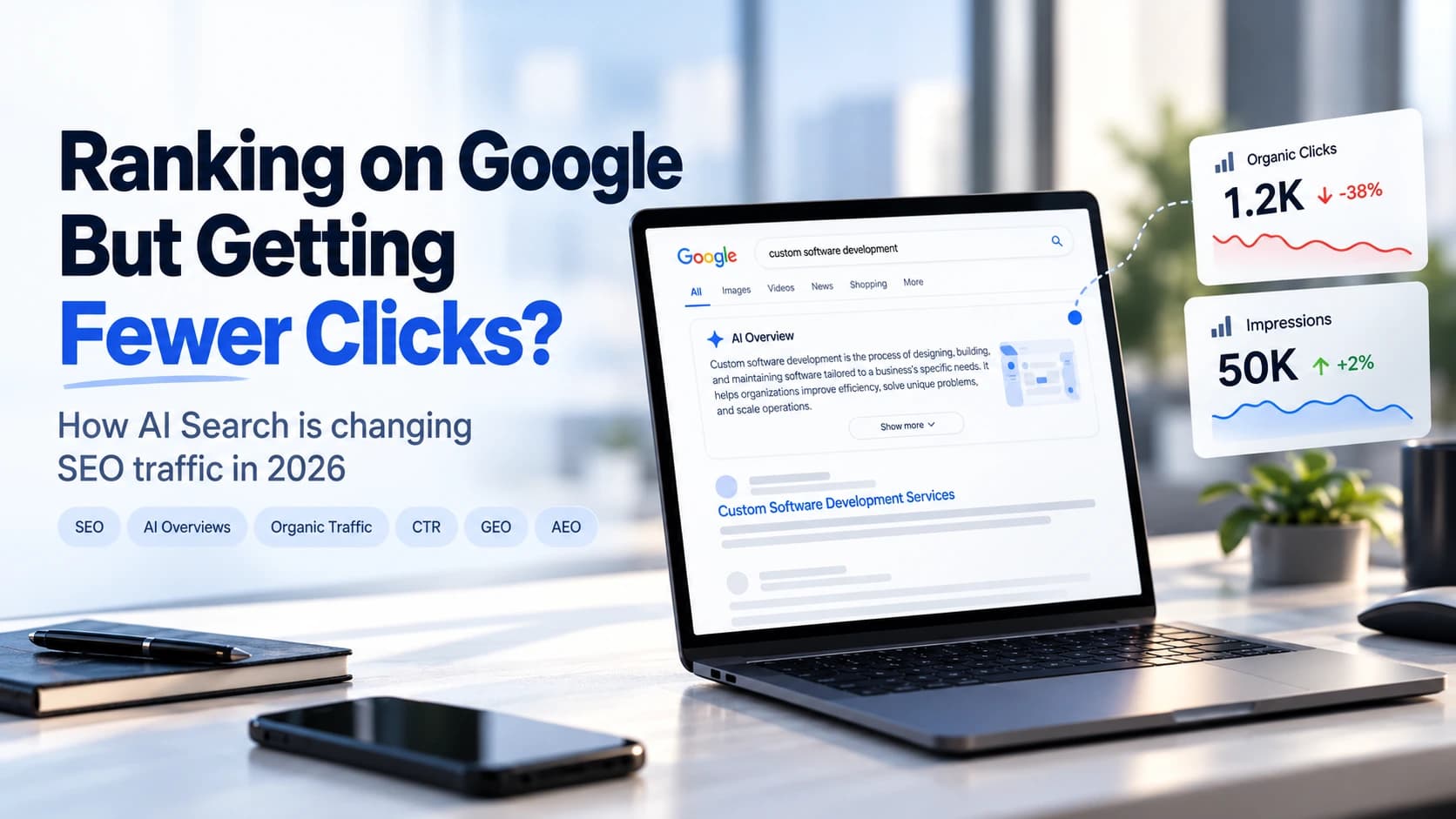
Your website is still ranking on Google. Your pages are appearing in search results and your impressions look healthy. Yet fewer people are visiting your website than before.
For a business that has invested time and money in SEO this can be frustrating. The content is published. The keywords are ranking. The technical issues seem resolved. But the traffic numbers tell a different story.
The reason may have less to do with your rankings and more to do with how people use Google today.
With Google AI Overviews and AI Mode users can receive answers directly within search results. Some questions that previously required visiting a website can now be answered without leaving Google.
But AI is not necessarily responsible for every drop in organic traffic. Changes in search intent and competition can create similar results.
The challenge for businesses is understanding what has changed and finding a reason for visitors to choose their website.
Why Good Google Rankings No Longer Guarantee Clicks
Traditional SEO has always focused heavily on rankings. The higher a page appeared in search results the more likely it was to receive visitors.
Rankings still matter. But they no longer explain the complete picture.
Consider someone searching for the meaning of a technical term. Previously they might open a blog post to find the definition. Now Google may display an AI generated explanation above the traditional search results.
The user gets the answer and moves on.
This behaviour is supported by research.
A 2025 study by Pew Research Center found that users clicked traditional search results in 8 percent of visits when an AI summary appeared. When there was no AI summary the figure was 15 percent. Source: Pew Research Center
These findings show a meaningful difference in observed clicking behaviour. They do not mean that AI summaries cause the same reduction for all websites or search queries.
Some people still need detailed information. Others want professional services or direct assistance that a short AI answer cannot replace.
The opportunity is to understand which searches still require a website visit and create content that serves those needs.
First Find Out Why Your Organic Traffic Is Dropping
Before rewriting your website or changing your SEO strategy you need evidence.
Google Search Console is the best starting point for understanding how people discover your pages through Google.
Open the Performance report and compare two similar periods. Review clicks and impressions alongside click through rate and average position.
These four metrics reveal different parts of the problem.
Impressions show how often your website appeared in search results. Clicks show how often users selected your website. Click through rate measures the percentage of impressions that resulted in clicks. Average position helps you understand where your pages generally appeared.
Imagine a website received 50000 impressions and 2000 clicks during one month.
Its click through rate was 4 percent.
The following month impressions remained at 50000 but clicks fell to 1200.
The click through rate dropped to 2.4 percent.
This example suggests that visibility remained similar while fewer impressions resulted in visits. It does not identify the cause on its own.
The next step is to examine individual pages and queries.
Look for pages where impressions remain stable but clicks have declined. Compare average positions for their main queries. Check whether the drop affects mobile users more than desktop users.
Also review whether the change appears across the entire website or only certain articles.
A traffic decline that affects informational content but not service pages may require a different response from a decline affecting the entire website.
How to Check Whether AI Overviews Are Affecting Your Visibility
Google introduced dedicated Generative AI Performance reports in Search Console during 2026. These reports became available worldwide by the end of August. Source: Google Search Central
They help website owners understand how often their content appears within generative AI features such as AI Overviews and AI Mode.
The dedicated reports include impressions along with information about the pages shown and their visibility across different countries and devices.
However these reports should not be confused with the standard organic search performance report.
AI visibility is not the same as a website visit.
A page may appear in an AI generated answer without receiving a click. That appearance can still create brand exposure but it should not be counted as an actual visitor.
Use the new visibility reports alongside your usual Search Console performance data.
If your informational pages receive substantial AI visibility while traditional clicks decline there may be a relationship worth investigating.
But this pattern alone does not prove that AI caused the traffic loss.
Not Every Traffic Decline Is an AI Search Problem
AI Overviews are receiving considerable attention. That makes it tempting to blame them whenever website traffic falls.
Sometimes the actual problem is more familiar.
A competitor may have published a stronger article. Your page title may no longer match what people want. A technical issue may prevent certain pages from appearing correctly.
Search demand can also change throughout the year.
A blog that performed well during a particular season may naturally receive less traffic later.
Businesses should investigate ranking changes and indexing problems before assuming that AI search is responsible.
Review affected search queries and inspect the current results manually. Check whether competitor pages are answering the question more effectively.
If rankings have fallen then improving content quality and technical SEO may be the priority.
If rankings remain stable while click through rate declines then the problem may be connected to how the search results appear or what users are trying to accomplish.
The right solution depends on the actual cause.
Give People a Reason to Visit Your Website
This is where businesses need to reconsider how they approach content.
Imagine a software development company publishing an article titled:
What Is Custom Software Development?
The article explains the definition and lists common benefits.
It may be useful for someone learning the topic. But much of that information can be answered directly by an AI search experience.
Now consider another article titled:
How Much Does Custom Software Development Cost for a Growing Business?
This question requires more explanation.
The reader may want to understand development costs and the decisions that affect the budget. They may need to compare technologies or decide what features belong in the first release.
A useful article can explain the tradeoffs through practical examples.
It can show how project scope affects the budget. It can explain why integrations increase complexity and which choices influence future maintenance costs.
That information helps someone make a decision rather than simply learn a definition.
Businesses should create content that helps readers solve a problem or make an informed decision.
Detailed comparisons and original project examples can give visitors a stronger reason to open the full article.
Make Your Existing Content More Useful Before Publishing More
Publishing new articles is not always the best response to falling organic traffic.
Your website may already have pages that attract relevant searches but fail to satisfy the reader.
Start by reviewing articles with strong impressions and weak click through rates.
Check whether the headline accurately describes what the article answers.
Then review the actual content.
An article about software development costs should explain the factors that affect the price. A blog about website performance should include ways to identify problems. A comparison article should explain which option makes sense under different circumstances.
A reader searching for solutions should leave with enough information to make progress.
Original material can make an article more valuable.
This might include a documented technical example or a comparison based on practical experience. Businesses can also publish genuine case studies that explain the problem and the work completed.
Avoid adding statistics without understanding their context.
A useful explanation supported by reliable evidence is more valuable than a collection of impressive numbers.
Google's content guidance continues to emphasise original information and useful analysis that goes beyond material already available elsewhere. Source: Google Search Central
The goal is to make an existing page genuinely better rather than simply longer.
Improve Your Search Titles Without Making Empty Promises
Sometimes the content itself is useful but the search result doesn't communicate that value.
Imagine someone searching for reasons behind declining organic traffic.
A generic title such as SEO Tips for Better Results says very little about what the reader will learn.
A more specific title such as Why Your Google Rankings Are Stable but Clicks Are Falling addresses a recognisable problem.
The second title makes the purpose of the page clearer.
Descriptions should follow the same principle.
Explain what the article covers and what the reader can expect to learn.
Avoid exaggerated promises or claims that have no support.
A stronger title can encourage relevant users to investigate the page. But a title change cannot fix content that fails to answer the search query.
The article must deliver what the search result promises.
SEO vs AEO vs GEO: What Should Businesses Focus On?
Search is changing but traditional SEO has not become irrelevant.
SEO or Search Engine Optimization focuses on helping search engines discover and understand your website while improving its visibility in organic search results.
AEO or Answer Engine Optimization focuses on making information clear enough to answer specific user questions directly.
GEO or Generative Engine Optimization focuses on improving how content can be discovered and represented within generative AI search experiences.
These approaches overlap.
A technically accessible website with useful content supports traditional search visibility. Clear explanations and direct answers can also help users and AI systems understand what the page contains.
For example an article discussing website traffic should explain what click through rate means before discussing how to improve it.
That definition should be accurate and easy to understand.
The article can then expand into examples and practical solutions.
Google has stated that websites do not need special AI markup or separate AI files to become eligible for its generative search features. Source: Google Search Central
Strong SEO fundamentals remain relevant.
The best starting point is useful content supported by accessible website structure and clear information.
There is no reliable shortcut that guarantees your business will appear in an AI generated answer.
Measure Business Results Instead of Rankings Alone
Organic traffic is important but it is not the final goal for most businesses.
A software development company wants relevant inquiries. An online store wants purchases. A service business wants potential customers to make contact.
A website can lose some informational traffic while still attracting valuable visitors.
For example a company may previously have received 10000 monthly visitors with 20 qualified inquiries.
A smaller audience of 7000 visitors could still produce more business if those visitors are actively looking for services.
These numbers are illustrative but the principle matters.
Traffic quality deserves attention alongside traffic volume.
Use Google Analytics 4 to understand what visitors do after reaching your website.
Track contact form submissions and other meaningful actions. Compare conversions across landing pages and organic search traffic.
Look at which articles lead readers toward relevant service pages.
This helps businesses evaluate whether their search content is contributing to real outcomes.
Rankings tell you where your content appears.
Conversions help you understand what happens after someone arrives.
A Practical Plan to Improve Organic Traffic in 2026
Recovering from a traffic decline should begin with a focused review rather than a complete website rewrite.
A practical plan includes four stages:
- Find the affected pages. Use Google Search Console to identify pages with declining clicks and compare impressions alongside positions and search queries.
- Investigate the search results. Check whether AI answers appear for the affected queries. Review competing pages and identify changes in what users may expect.
- Improve content where needed. Update weak explanations and add useful examples. Improve titles and internal links. Fix technical issues that affect access or indexing.
- Measure the outcome. Compare results after changes have had time to take effect. Monitor organic clicks alongside engagement and conversions.
Not all improvements will lead to immediate results.
Search demand may fluctuate and Google needs time to discover and process website changes.
Avoid making several unrelated changes at once if you want to understand what actually helped.
Consistent measurement is more useful than reacting to a single week of declining traffic.
What Does This Mean for Businesses Investing in SEO?
The rise of AI search does not mean businesses should abandon SEO.
It means their expectations need to become more realistic.
Informational searches may not create the same clicking behaviour they once did. But users still need websites when researching services and comparing options or looking for detailed evidence.
A business should understand which topics support awareness and which topics attract potential customers.
Some articles will introduce the brand to new readers.
Others will help people evaluate a solution.
Service pages should make it easy for interested visitors to understand what the business does and how to get in touch.
Together these pages create a more useful website than a collection of articles written only to target popular keywords.
The question is no longer simply how many people see your website on Google.
It is how effectively your content helps the right people discover your business and take the next step.
Final Thoughts
Seeing fewer clicks despite stable Google rankings can be concerning. But it doesn't automatically mean your SEO efforts have failed.
AI Overviews are changing how some users interact with search results. Competition and search intent continue to influence traffic as well.
The solution begins with understanding your own data.
Use Search Console to identify where clicks are being lost. Review how your pages appear in search results. Improve content that fails to answer real questions and track what visitors do after reaching your website.
Businesses that focus on useful information and measurable outcomes will be better prepared to respond as search continues to change.
The aim is not simply to recover clicks. It is to earn visits from people who genuinely need what your business offers.
Need Help Understanding Why Your Website Traffic Is Falling?
If your rankings remain stable but your organic traffic is declining then the first step is understanding what has changed.
WanderCode can help review website performance and identify technical SEO issues alongside content gaps and opportunities to improve search visibility. Explore our digital marketing services.
Understand your traffic. Improve what matters. Turn relevant search interest into business opportunities.
Related Blogs
AI & Automation
AI Coding Agents Are Writing More Code. Who Is Responsible for What They Ship?
AI coding agents can create code faster than teams can review it. Here is how to keep changes focused, assess risk, and retain clear ownership of production releases.
AI & Automation
The Real Cost of AI Automation in 2026: Where Your Money Goes and How to Cut the Bill
Understand where AI automation spending goes, from models and agent loops to RAG, infrastructure, and human review, and learn how to reduce the bill.
AI & Automation
Is n8n the Future of AI Automation? What AI Agents Can—and Still Can’t—Do in 2026
n8n is changing how businesses build AI-powered workflows. Explore what AI agents can automate today, where human control still matters, and what the future of AI automation may look like.
Design
Designing Trust Into Modern Fintech Products
Trust is the real currency of fintech. Learn how thoughtful UX, transparency, security cues, and clear product design help users feel confident with every financial interaction.
WanderCode Team